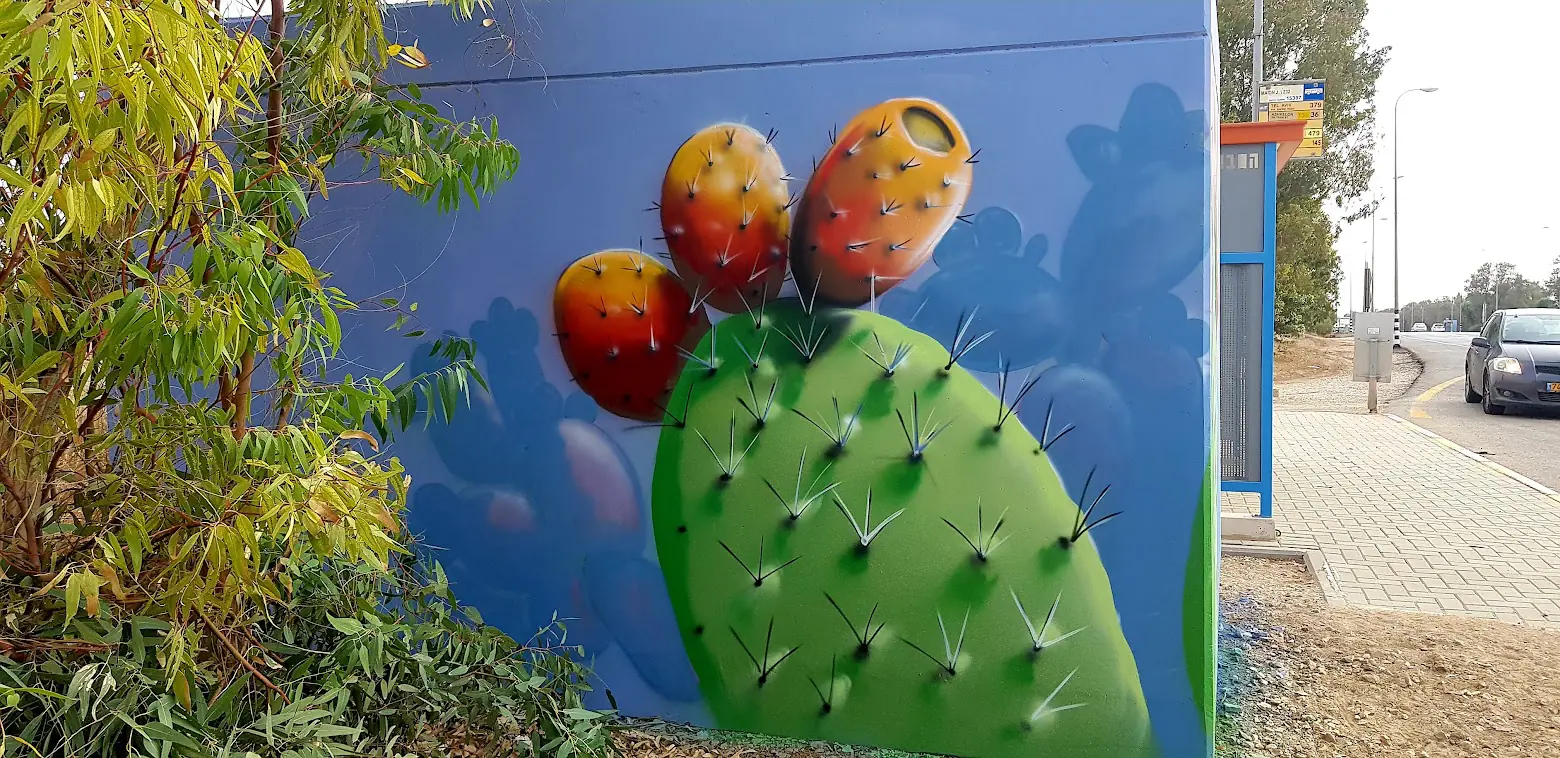
Cactus Art Shelter ~ Maon Junction ~ JNF-USA

The Sponsor: JNF-USA

Site southwest of Gaza, called Menois in Roman times. It is now identified with Ḥorvat Ma’on (Khirbat al-Maʿin) near Nirim, southeast of Gaza. Remains of mosaic pavements and other debris show that the area contained an extensive settlement from the fourth century c.e. onward. The most interesting building is a synagogue which was excavated in 1957–58. It is oriented toward the northeast and consists of a hall, 14.8 × 11.8 m., with two rows of four columns forming the nave and two aisles. In the vicinity was a ritual bath (mikveh). The stone-paved aisles and narthex form a sort of ambulatory around the mosaic-paved nave. The design of the mosaic shows a vine trellis issuing from an amphora flanked by peacocks; the trellis forms medallions within which pairs of various animals are represented. The section of the pavement nearest to the apse has symbolic designs: two palm trees with doves at their bases and above them a menorah with two etrogim, a shofar, and a lulav, flanked by two lions. The Aramaic inscription mentions the congregation as a whole and three individual donors of a gold dinar each. The pavement, which dates to the early sixth century, has an interesting parallel in a church pavement found at nearby Shellal. They were both, according to Avi-Yonah, made in the same workshop in Gaza.

Adapted from encyclopedia.com

Name of the Community: Eshkol Region

About this Art Shelter:

Most people know that a native Israeli is referred to as a Sabra (tzabar in Hebrew). However, not everyone knows what a Sabra really looks like (not the human variety). A Sabra is actually a form of cactus, Opuntia ficus-indica, in the past known as a ‘prickly pear’ and now most often called a ‘cactus pear’. The fruit of the Sabra is thorny on the outside with a thick peel that must be removed, to get to the sweet meaty inside. Most of the fruit (in Israel) ripens within a short two-week period, in the summer, typically in mid-July to mid-August. But, due to arid desert conditions in parts of Israel cactus pears can be harvested ten months a year. These cactii are prevalent in the Western Negev and used to be used as natural fences or barriersץ

Adapted from Gems in Israel

The Art Shelter